Cutest Blog and Widdlytink


My Stick Family from WiddlyTinks.com
Showing posts with label product. Show all posts

Nov 7, 2017

Innovators Tribe ~ A Homeschool Crew Review


When Innovators Tribe showed up in the upcoming vendor list for the Crew, I sent Dad the link and asked if he thought Xav would be able to use the course in any meaningful way.  Xav's my STEM guy.  Well, minus the "M" - math.  He loves experiments and hands on work.  Thinking Like an Engineer looked like something right up his alley.  Dad said he thought Xav could do it, but he knew he would definitely LOVE the course.  Wayne Kroeplin's (Mr. K) courses are for grades 6-12 with some wiggle room.  My punks are in 5th and 6th grade, but math is a struggle.  *So far* math hasn't been an issue at all.  They haven't needed it for anything.  Not even to succeed in the challenges.  The best part about this class is that you are *encouraged* to invite everyone in the family to participate *together*.  This has given us some fun memories of supporting and working alongside each other.  (And believe me, those moments are few and far between.  We seem to be in a very competitive stage.)


Thinking Like an Engineer is a pre-recorded online course.  Pacing is decided by you and your family.  We took a pretty leisurely pace and generally watched one lesson or completed one challenge each week.  Certainly, your students could work at a faster pace.  I think a video/slide show lesson plus a challenge (or more!) in the same week is completely doable.  At one lesson and one challenge, you would spend about 2-3 hours on the course for the week.

Each unit has a "journal" to fill in with the information found in the videos, sort of a guided notetaking page.  The lessons also have assignments.  We've had various amounts of success with the journals and assignments.  One assignment is learning about an engineer that is involved *somewhere* with a topic in which the students are interested.  Well, Mal is only interested one kind of "engineer" and that's a *train* engineer.  I have directed him to transportation engineers and we've looked up how engineering is used in the design of trains and railways.  It isn't quite the same, but he was willing to learn a bit about it.  Xav was interested in engineering as it applies to Lego toys.  While we found listings for job openings in engineering for Lego, they were in a foreign language.  Most of what we found was about designing Lego sets.  So, the researching engineers part didn't go great for us, it was good practice at online researching and we did learn a bit.
Innovators Tribe What You Get

The units include:
  • Intro to Engineering
  • Intro to 3D Design
  • Engineering Rollercoasters
  • Engineering Bridges
  • Nano Engineering
  • Thinking Like an Engineer - Course Conclusion
I thought I'd tell you about some of our favorite activities and challenges to give you a feel for the course.  Lesson 3 is called Engineering Clean Water.  While I watched the lesson and the associated outside videos, I remembered the PlayPump.  Does anyone else recall the water pump that was run by children playing on a Merry-Go-Round?  I always thought that was genius.  Unfortunately, when I looked it up recently, I found out it didn't end very well, for the most part.  Throughout the Thinking Like an Engineer course, we were encouraged to be innovators and try new things.  Even though the PlayPump doesn't work well in all situations, it was definitely innovative.

In lesson 4, you receive the 3D Design software that you will use to create bridges and roller coasters.  We aren't using this yet (so close), but I know Xav especially is going to love it.  He eats that kind of thing right up!

Thinking Like an Engineer

The challenges have been a blast!  Some times we don't handle failure very well, When we have worked on the challenges, there has been an "Oh, rats!" or three, but no one has been angry about starting over and rethinking the processes.  We have had so much fun completing these tasks together.

Our first hands on challenge was to try to construct towers using regular copy paper.  Well, the punks were a bit disappointed, because Mr. K said some students had built their towers a couple feet taller than they did.


His class also stacked more books than we did in the second challenge.  We used one sheet of paper and had two feet of masking tape for this challenge.  We tried fan folding, circles, and concentric circles.


This happened a lot.


 And this.


But through all the challenges we faced, we brainstormed our way through to make the best of the assignment and to figure out what we could do differently or better to improve our results.  Eventually, we got to this.


If I had made just three or maybe four rings, even though they were super tiny, I would have had more stability and been able to stack books higher.

Our third challenge was creating a crude water filter using information from an Environmental Protection Agency video.  We didn't complete that challenge here at home, because a class in our co-op recently did this.  (Hmmm... As co-op yearbook creator, I thought I had taken a picture of that lesson, but it appears I did not.) 

The one thing I really wished for was the "solution" to the challenges.  How did Mr. K's class get 200 POUNDS of books on the single sheet of paper?  HOW?  I need to know!  Maybe gEEk Dad can tell me.  The punks and I absolutely love the hands on quality of the coursework and they really like the videos.  They've learned a lot of information seemingly unrelated to engineering.  I think they especially liked the clean water challenge and we could tell that it was an important problem to Mr. K.

I also enrolled in the free Think Like an Innovator course.  I think the punks are going to like it, too!  Mr. K offers another course, Thinking Like an Architect, also for grades 6-12.  Some of my CrewMates reviewed that as well.  So please click below to read some of the other reviews.


Thinking Like an Architect or Engineer {Innovators Tribe Reviews}


Crew Disclaimer

Aug 8, 2017

Hey, Andrew! Teach Me Some Greek ~ A Homeschool Crew Review


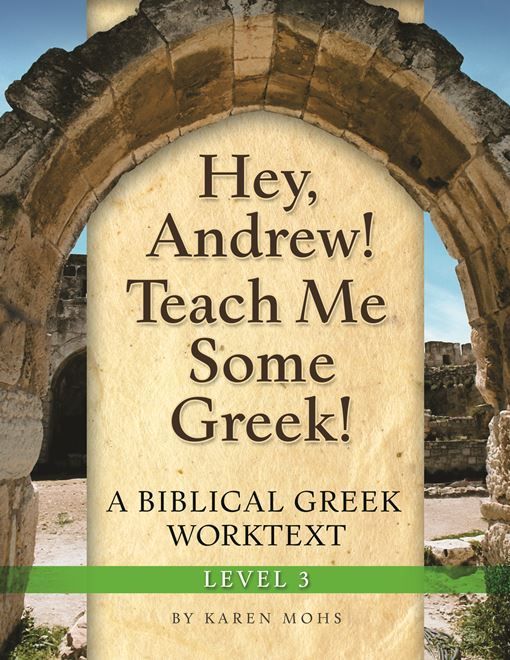
Through the Homeschool Review Crew, we get to try out so many different Christian curricula that I never thought would be possible.  (Maybe I should say "curriculums" because the internet tells me that is the American plural of curriculum, while "curricula" is Latin and, today, I'm here to talk Greek.)  Greek 'n' Stuff's Greek courses have been on my radar for many years.  When Hey, Andrew! Teach Me Some Greek! - Level 3 Set became available to The Crew, I thought it would be so fun to try.


What did I receive?  Well, I'm glad you asked.
  • Level 3 Worktext - A spiral bound, soft cover, with 170 pages of lessons, plus an appendix which lists things like Greek to English and English to Greek translations of the level three vocabulary, alphabet, breathing marks, tense, and gender.  Instructions for Bible copywork are also included here.  (I've ordered a Greek interlinear New Testament, and I'm pretty excited about that.)  This is followed by the index, a feedback form, and then the all important flash cards (more about those in a minute).
  • Level 3 Answer Key - Also a spiral bound, soft cover, this answer key boasts full size duplicates of the lesson pages (with answers) and the appendix from the worktext.  The suggested (and easy to follow) schedule is to complete one page per day and review the flashcards.  Author Karen Mohs clearly explains how to use the books and CD.  Each lesson is listed with the topic, pages, and teacher tip, and often a "big picture" chart showing the progress being made through the topics in the appendix.
  • and the pronunciation CD - this covers vocabulary for Level 3 and Level 4, includes the alphabet song, and speaks through the charts in the appendix.  The included chart lists exactly what page's vocabulary is on each track.
Hey, Andrew!Teach Me Some Greek!

Several resources are suggested and some are also available from Greek 'n' Stuff.  The Bible is the only extra purchase I've made.  You certainly don't *need* anything more than what is included in the set.

How did we choose a level?  Why, another excellent question.

While there are tests available under each Greek level and Greek 'n' Stuff has this nifty chart which shows all of the levels and options available for the Hey, Andrew! Teach Me Some Greek curriculum, I just went by their suggestions.  Children as young as preschool can begin to learn Greek with the reader.  As soon as children can control the pencil, they can start learning the Greek language using Level One.  You'll probably find Level Two just right for 2nd graders.  For older students, say 4th grade to adult, Level Three is the recommended starting point for beginners.  Since we know zero Latin (well, Dad knows a smidge from college), that seemed exactly right.  I think it has been a really good fit for Xavier.  Level Three contains a quick review of the information taught in Levels One and Two, so you're quickly up to speed.

What's it like?  You are full of great questions today!

I was definitely a little intimidated by the whole "learn a whole new alphabet and all the sounds each cute, but funny looking letter make."  Xav has kind of enjoyed it, though he is never keen on any writing.  "Zeta is hard to write.  I can tell you that from experience," Xav tells me.  This photo shows the beginning section where he started writing the letters of the Greek alphabet.  Rather than write three rows of three letters each day, I got this idea to write one row of each letter every day for three days.  For example, the first day he wrote one row each of alpha, beta, gamma.  On day two, he wrote one row of each of those plus one row of delta, epsilon, zeta (Ah, zeta.  yes, he did have trouble with that!).  Day three was the last day of alpha, beta, gamma plus the second row of delta, epsilon, zeta, and the first row of eta, theta, iota.  We rotated our way through the alphabet that way to omega.  It took about the same amount of time, but simultaneously broke things up and kept the letters in his head for more days.  While writing, he practiced saying the letter's name and sound.

Once the alphabet writing was done, the work pages began.  These pages were mostly pretty enjoyable.  Some pages are writing intensive, but many of them are matching, circling, drawing, and even completing crossword puzzles.  This photo show some pages as he completed them and the following photo shows a few examples of the worktext yet to come.  You can see there is a wide variety of activities.


You are encouraged to use the flashcards every day.  (You get to check off a box on each page - see the pics above.  I love marking things done!)  These cards are in the back of the Worktext, six cards to each page.  The front and back are in two columns.  We just cut each pair out, folded in the center and covered with tape.  I think the rest of the pages will be laminated though.  They'll be so much sturdier.  Greek 'n' Stuff does carry a cardstock set that is already cut and hole punched, so that is an option.  Anyway, Xav happily helped me cut out, tape and trim his first cards.  They also sell quizzes for the testing inclined.


The music CD is 68 tracks total.  The first one is an alphabet song and is kind of catchy.  The Level Three vocabulary follows on tracks 2-21.  Each track says, "(Vocabulary word) means (translation).  (Vocabulary word)"  I'll use track 2 as an example.  "An- thro-pos means a man.  An-thro-pos."  Short and clear.  Level Four vocabulary continues to track 59, then tracks 60-68 (thankfully) cover the information on the charts from the appendix.


If you're looking for a Greek program, I think this one is very good.  The variety of activities and the review seem to help it stick, despite the learning of a completely new alphabet.

Greek 'n' Stuff also carries Bible studies and Latin curriculum.

Find Greek 'n' Stuff on social media.

Teach Me Some Greek {Greek 'n' Stuff Reviews}


Crew Disclaimer

Aug 3, 2017

Heirloom Audio's In the Reign of Terror ~ A Homeschool Crew Review


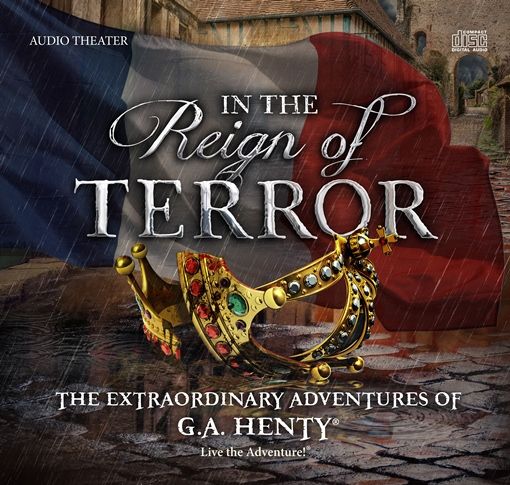
We love the Heirloom Audio Productions audio theater here. I have all but two. For now. This time, we were whisked away to France during the French Revolution. In the Reign of Terror actually begins in America, with Mr. George in Arlington Cemetary. As usual, our boisterous story teller has found a willing listener to one of his many amazing tales. Young American Harry is about to be treated to the telling of young British Harry and his time abroad. We head to France along with Harry as he is sent to spend some time with a Marquee and his family.


Harry knows there is a troubling time ahead, as Paris is in turmoil, but his father is confidant that things will soon settle down. Through several harrowing minor adventures, Harry earns a place in the hearts of the Marquee's family members. But the real adventure hasn't even yet begun.

As I researched this G.A. Henty title, I was a little concerned about the amount of death that would be taking place in this story. My middle little punk is so tenderhearted and the French Revolution was a very dark time. The death is terrible and even some major characters lose their lives, but through it all, they are more likely a second hand mention, and we are not privy to the actual acts. That isn't to say there are no disturbing passages. No one skirts around the horrible ways many of the deaths happen, it just isn't highlighted. It is just mentioned in as sensitive a manner as possible. We've listened to In the Reign of Terror several times in the past few weeks. I've had to answer some questions with sad answers. Unfortunately, 1790s France isn't the only time in history with sad answers.

One thing I really liked was the juxtaposition of the French Revolution and America's Revolution (or War of Independence). Henty repeatedly contrasts the two events. While they took place closely together in time, the differences were startling. God was generally foremost in the hearts and thoughts of the colonists, while Europe was experiencing the Age of Enlightenment, in which man did not need a god to attain perfection. While researching more about the Enlightenment period, I saw the two revolutions lumped together, rather than different. I liked hearing and reading Henty's opinions on the relationships and differences. One thing I think was most important is that *in general* the American war was fought as soldiers against soldiers, while the French war was largely a people (the common people) pitted against a people (the wealthy nobility and the clergy). Age, guilty involvement, treatment of the poor in general were not taken into consideration.

Admittedly, most of my knowledge of the French Revolution and Reign of Terror actually comes from viewing The Scarlet Pimpernel (1982). Let's just say, funny as it is, it may have left some gaps in my knowledge. While I still don't know everything about this period, Henty and Heirloom Audio Productions has helped me round out that knowledge.

In the Reign of TerrorAs always, the actors are stellar, the screen play is phoenomenal, and the sound track and audio effects stir something in our very hearts. Brian Blessed, as G.A. Henty (Mr. George) is so memorable and imposing. I confess, his story telling is one of my favorite parts of every one of Heirloom Audio's productions. When I read Heirloom Audio's Facebook updates, I read them in his booming voice. They might (or might not) have a tiny little 20 year old woman on their social media, but she sure sounds like Brian Blessed to me!

Some things about Heirloom Audio Productions have changed since I last wrote a review for them. The helpful study guide is no longer included as a download bonus when you purchase the CDs or MP3s. Those are now part of the Live the Adventure Club. The club is a subscription to the online service and the bonuses are included in that. With club membership, you receive several bonuses which include the study guide, lots of unique resources, a forum, and soundtracks and ebooks for the Heirloom Audio adventures you own. Club membership also includes THREE physical CDs sent out yearly. YIPPEE! More for listening on those long car rides.

Anyway, about that study guide. My one problem with the guide is that the beautiful pages are not printer friendly. I will say this every time I review it until there is a black ink on white paper only option. The guide is broken down into questions for each track of the audio. Each set of questions is divided into three types: Listening Well – a sort of comprehension section, Thinking Farther – which requires the student to consider motives of the characters and use other critical thinking skills, and The Defining Words – or vocabulary.  I really like the Thinking Further section, though it's the hardest part for my punks.  It asks questions like "The Bible forbids rulers and judges from taking bribes (cites verses)...  Do you think it is wrong to bribe an official in order to get real justice?  Explain your answer."


One thing we like about the study guides, which really make a nice unit, is that there is generally a recipe in them. The study guide for In the Reign of Terror has a brioche recipe. I want to make it! But it's summer. I will probably have to take the toaster oven out on the porch so I can bake some bread soon. Otherwise, it's going to have to wait a month or two.

The guide also includes short biographies of G.A. Henty, Robespierre, and Marie Antoinette, and further information about the Age of Enlightenment and the French Revolution. Expand Your Learning segments and photographs are inset on several pages throughout it. Further study suggestions are listed, including the book the script writers were asked to read. Bible studies follow, with the topics “When God Means Evil for Good,” “Resisting Tyranny,” and “True Manliness.”

Heirloom Audio Productions' CDs are well loved in our homeschool.  Check out the Live the Adventure Club and receive Captain Bayley's Heir.  Get to know some of the Heirloom Audio folks and chat with other parents.  You'll find unique resources and plenty of fun activities for your punks, too.


Find Heirloom Audio on social media.
Facebook
Twitter 
Google+  
Instagram: @HeirloomAudioOfficial


In the Reign of Terror {Heirloom Audio Productions Reviews}


Crew Disclaimer

Aug 2, 2017

English on a Roll ~ A Homeschool Crew Review


We've all heard those (accurate) jokes about how difficult it is to grasp all the nuances of the English language.  I love it.  I use it daily.  And yet...  some days...  I don't use the English so good.  This might just be the most horrible thing a homeschool mom can say:

I don't remember how to diagram a sentence.

I'm not even 100% sure I ever learned.  I haven't taught my kids to do it either.  Can we still be friends?  With English on a Roll's English Grammar Teaching Method you won't have to know how!


When I saw the video demonstration, I was really intrigued.  I thought it was so clever to have manipulatives for LA, because they work well for math (with Malachi especially, but all of them really).  Grammar is a tough one here, and while we have used another program, there was more writing than the boys were really prepared to do.


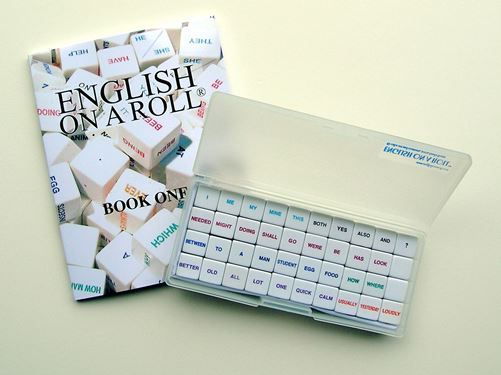
English on a RollI received a paperback copy of English on a Roll Book One by Linda Hopkins Koran.  The book is 142+ pages.  There are 37 lessons, including review.  At the beginning of the book is a chart of all the cubes, their color, and the full list of words on each.  The importance of manipulatives for tactile learners is discussed, but it's important to note that the techniques used in teaching with this method include the Multisensory Structured Language (MSL) principles.  These principles include teaching to all learning styles, building up from a basic foundation, repetition and review, and several other forms of reinforcement.


Thirty-eight cubes are color-coded by parts of speech.  The box also includes two completely blank cubes to customize your own word blocks.  To make that super simple, a small sheet of 30 labels is included.  The words are actually engraved on the cubes.  I think that will help them hold up to lots of use.  The words on each cube are all used in the same way, so while rotating a cube to find the correct word, the student learns the other words are all related.  One cube set can be used for up to six students. 


The English Grammar Teaching Method can be used with anyone, aged five and up.  The program is helpful for ESL, special needs, and beginning reader programs.  Thankfully, I don't even have to know how to diagram a sentence to teach it.

We began with the blue subject pronoun cube (I/you/he/she/it/they/we).  Yes, I know that is seven words and a cube, by definition, is six-sided.  He and she share a diagonally scored face of the cube.  The same comes later with his/hers and who/whom.  You get the idea.  You will only provide the few cubes required for each lesson.  Close the box and put away the rest.  Trust me on this one.  Oh, speaking of the box, you open it upside down so the cubes are in the lid.  Genius.  Have you ever tried to dig tightly packed, slick cubes out of a deep box?  I did.  Because I seriously needed training in the proper opening procedure!


While the first lesson or two, I worked alone with Xavier while Malachi was in a meeting, I decided it made much more sense to work them through the program together.  They seemed to be a bit embarrassed, though, to do some of the activities in front of each other.  So, while *logistically* I wanted them to work together, in reality, my punks did better work separately at the beginning of the course, when they felt the lessons (and actions) were "babyish."   It wasn't long before the lessons became more like the workbook pages they are used to and the script involved less obvious points and fewer repetitions.

Each lesson consists of several parts.
  • Prep - Which cubes, printouts, and other items you need for this lesson.
  • Teach the Concepts - Talking over, demonstrating, or acting out the lesson.
  • Conversation/Games - Rolling an "anchor" cube (the basis you will build around), building combinations, customizing cubes, etc.
  • Written Exercises - Using the included worksheets.


The lessons are completely scripted.  Remember, I said you didn't have to be a grammar whiz to teach this course.  The worksheets for each lesson are included in the book and completely reproducible for your family/class.  Conveniently, they are simple illustrations and words, and do not require color ink or waste a lot of black ink.  That is *my* kind of worksheet.  I do wish the book were spiral bound or the reproducibles were in a separate packet or on a disc.  Copying from a perfect bound book looks sloppy and, eventually, the binding tends to break.


The whole program is so portable, we were easily able to bring the cubes and book along to Grandma's so there were no excuses for forgotten material after we returned from vacation!

I like this program and the punks *really* like that there isn't a lot of writing required of them for it.  It's nice that I can teach grammar with minimal writing, the manipulatives help it stick, and most of it is pretty fun. 


Find English on a Roll on Facebook.


English on a Roll {Reviews}

Crew Disclaimer

Jun 22, 2017

UnLock Math ~ A Homeschool Crew Review


UnLock Math is a family business, founded by Matthew and Alesia Blackwood.  We received a one year subscription to UnLock Pre-Algebra for one child to review.  Before I really knew anything about UnLock Math, I researched their products and I had a short chat one evening with Matthew.  I didn't expect to hear from him until the next day, since it was so late in the evening, but he got right back to me and we briefly chatted about UnLock Pre-Algebra and the newest Geometry course.  Matthew was super helpful and I really appreciated that he took the time to connect at that time of night.
UnLock Math pre-algebra
I ended up deciding to start UnLock Pre-Algebra with Mal.  It seemed pretty straight forward and I thought he could do the work.  Unfortunately, he got stuck on the first unit and struggled so much.  I wasn't sure if I should let him move ahead whether he got whole and natural numbers or not, or keep going over it, or start having Xav work through the course.  I wish now, I had asked Matthew his opinion.  Instead, I put Xav on the course.  It went a bit better with him and he was able to complete some of the work, but in order to give you more information about the course than I was able to at that point, I decided to start working through some of the course myself.


Each lesson consists of the following:
  • Warm Up - 5 questions that cover the previous lesson.
  • Video Lesson - Alesia teaches and demonstrates the lesson in an easy to understand video.
  • Practice - Ten problems using the information just learned in the video.  If they miss any, they can see the how and why afterward.  This section offers unlimited practice, as often as needed, with new questions each time.  Only the best grade is recorded.
  • Stay Sharp - These are all review questions of the topics previously covered.  This section can also be completed as many times as needed.
  • Challenge Question - A single question.  It doesn't count toward their grade if they miss it.  It does award bonus points, though.

Click the image to see a challenge question.

After several of these segments, there is a five question quiz, then a test at the end of the unit, plus a mid-term and Final exam.

The Student Dashboard is where you find the Welcome Letter, Progress Report, Gradebook, access the formula sheets, schedule, and reference notes, as well as enter into the lessons the student is taking.  The reference notes can be printed to make a handy pre-algebra notebook.


Lessons

The list of each bite size chunk of a lesson, is super easy to navigate.  Just click on the desired unit and "launch" it with the rocket icon.


From here, you select the day's lesson, which takes you to the page with the individual components of a complete lesson.  I like the dotted path that guides students through each component of the lesson.  It's a great visual.  I would have liked to see a marker of some sort that showed which sections have been completed, or at least attempted.  Otherwise, my punk would just start all over again each day.  If you or your child are able to keep track of which component they need to start with, the program *does* keep track of the amount of completion within that.  So, if they have started a session and need to quit, the program saves progress to the last time they clicked "next."


Grading

Your Student Gradebook is from Maple T.A., a testing and assessment software.  Maple T.A. provides automated grading throughout the course.  Here, you can see each assignment the student has worked on, the status of the assignment (a yellow arrow in a circle or a green check mark in a circle), details (which is where you can see the same details from the main guidebook, as well as the process or concepts used to answer each question and compare that to what the student did), score and total (how many right out of the total possible), the start and end time with duration.  Very thorough and handy.


I do find the whole system for the grading to be very confusing.  Because, this doesn't equal 57%, it's 44%.


But in the Student Welcome Letter, I see this list of weighted grading.  Now, it kind of makes sense and perhaps those percentages equal 57% when calculated in this manner, but I am not a algebraic thinker, so in *my* reality, I'm just more confused.


In summary, while the grading is confusing, I would recommend UnLock Math to parents of older students.  The customer service is very helpful, the videos are appealing and don't talk down to students, and that unlimited practice can be a huge benefit.

UnLock Math offers homeschool math curriculum for middle school and high school.  Be sure to check out the rest of the Crew's reviews of UnLock Pre-Algebra, UnLock Algebra1, UnLock Algebra2, and UnLock Geometry which is the newest course they are offering.


UnLock Math

Find UnLock Math on social media.

Pre-Algebra, Algebra and Geometry {UnLock Math Reviews}

Crew Disclaimer

Jun 13, 2017

Spanish with Whistlefritz ~ A Homeschool Crew Review


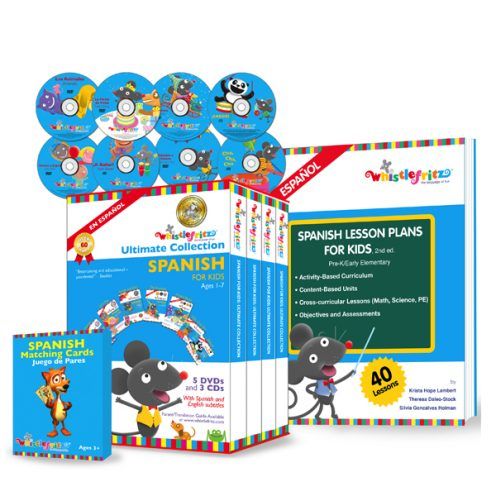
Hola.  How would you like to teach your littlest littles Spanish with a program that is designed *just for them*?  Whistlefritz has a program for 1-7 year old children.  Their award winning Educator's Spanish Collection is specially designed for young minds and abilities.  Foreign language learning has been determined to be easiest at an early age, just like children learning their native language.


Whistlefritz uses immersion learning to introduce children to Spanish without using English translations, which actually slow down foreign language learning.  My brain likes to slowly process everything, so when I was learning Spanish (or, more accurately, failing to learn) in college, I was so slow.  I would listen, think "He said..." and translate to English in my head, attempt to translate back to Spanish in my head and then speak (poorly, because I knew the *words* but not the grammar - or flow of a sentence).  This earned me a grade that I quickly had expunged from my record and replaced with another elective.  I would love for my punks to have a much easier time with foreign languages that feel natural to hear and speak.


What you receive in the Educator's Spanish Collection?

    Whistlefritz Spanish
  • Spanish Lesson Plans for Kids, 2nd edition
  • 5 DVDs
  • 3 audio CDs
  • Matching Card Game
You can use this course with multiple children (in a family/classroom) and we sort of did that.  Even though the target age is 1-7 years old and Merrick is the only one I have in that age range, I did catch each of the bigger punks watching the videos with Merrick.  I even heard Mal translating the words into English, which is discouraged.  I don't think he was doing it for Merrick's benefit, though, but for himself.  He was just trying to have it make sense to *him*.  Xavier sometimes plays the card matching game with Merrick also.

The Lesson Plans -  The 40 lesson, softcover book is a thick 277 pages.  Each lesson has several sections; a lesson description, goal, objective, vocabulary, a materials list, the approximate time each lesson will take.  This is followed by related activities.  The manual is written with both the English and the Spanish for all scripted conversations.  Song lyrics (Spanish only - English translations are available online) are listed under the lessons that utilize them.  As you move through the manual, you will be making your own set of Spanish flash cards.


I love all of the fun, reproducible sheets that are included in the lesson plan book.  There is an option to download some of the pages in color from the website.  I would like to be able to download the black line pages also, since it is difficult to print the pages bound into such a thick manual.  I think the easiest thing for me would be to cut off the binding, hole punch the pages, and place them in a three ring notebook. 


Merrick thought the lesson plan was a workbook.  He kept asking for his big, Spanish mouse book.  It took me a while to realize he wanted to do worksheets with Fritzi.  There are a lot of pages of fun activities that we copy and use, but he seemed to miss having pages to write on in the book.  (Finally, a kiddo after my own heart!)


The DVDs - Colorful Spanish videos for kids combine lively animation with live action native Spanish speakers of all ages.  The songs, visual aspects, and dialog are enchanting.  Who could resist a whole house search for an adorable, whistling mouse, while Maria calls out to him in each room?


  1. Los Animales - Animals
  2. Vamos a Jugar - Let's Play
  3. Adentro y Afuera - Inside and Out 
  4. Las Estaciones - The Seasons
  5. La Fiesta de Fritzi - Fritzi's Party

The DVDs did not have chapter selections, so you can't really watch the video segments as recommended in the lesson plans.  Mainly, we just watched the full episode, rather than a scene, of whichever DVD was listed in the lesson plan.


The CDs -These three disks are full of fun, lively tunes that make you want to dance.  My visual learners like them, but prefer the DVDs to see the context of what they are hearing.

  1. Sabor!
  2. Cha, Cha, Cha
  3. A Bailar!  - Let's Dance

The Matching Game - These cards are sturdy, glossy stock.  The instruction card has more than just matching game instructions, but also prompts in Spanish to encourage little ones to think (and speak) about the card they see.  There are optional ways to play with the very young.  Each card shows Rito the fox in the act of "doing" something.  The word is located at the bottom of the card in Spanish only.  They are divided into four colors, soft shades of blue, green, purple, and yellow.  There are 10-16 cards in each color.  I started Merrick using just one color of card at a time.  He has trouble remembering to turn the cards back face down when he turns two over that don't match and knows where the mate to one card is located.  He's worked up to two colors of cards, but I think all the cards would be overwhelming right now.  


The games and activities aren't *just* fun, though they are fun.  They're also science and math and art.  Merrick picked up a bag of Goldfish crackers a couple of days before the fish sorting lesson.  He had no idea he was going to need them for school, but as soon as I realized they were on the materials list, I realized I had to hide them so he couldn't eat them before we needed them for the activity!


As an example, in Lesson Two, Los Colores, Merrick learned about primary and secondary colors, which we had actually just talked about in an art class.  Fritzi was having a birthday party.  I did not have transparencies, but I have such a stash of "stuff" I was able to find clear page protectors.  I traced the balloon onto three sheets with a permanent marker and then we colored each one, red, yellow, and blue.  I asked Merrick what new color each combination of primary colors would make.  He did well except for purple.  Then we would lay the two colors down together to see if he was right.  Then we watched a scene from La Fiesta de Fritzi, where Rito the Fox gathers colored balloons.
 

Whistlefritz offers a free 28 page downloadable lesson plan book that is completely different from the physical book available in the Educator's Spanish Collection and a fun "Do you like...?" Fritzi booklet.  You do need the videos to make full use of that lesson plan.  But if you are looking for a simplified version of the program to use with the DVD/CD set or a supplement full of extra activities, do look into it.


If you would prefer to have your child learn French, Fritzi has that also!  The Homeschool Review Crew was able to review both Spanish and French.  Click the banner below to see what others are thinking of Whistlefritz.


Find Whistlefritz on social media.


Spanish and French {Whistlefritz Reviews}


Crew Disclaimer